What is an Agent?
Definition
While conventional software enables users to streamline and automate specific tasks, AI agents represent a significant evolution in this capability. An agent is an autonomous system that can perceive its environment, make decisions, and take actions to achieve specific goals.
AI agents are powered by large language models (LLMs) and are designed to perform complex, multi-step tasks with minimal human intervention. They can understand natural language instructions, reason about problems, and execute actions through tools and APIs.
Unlike traditional applications that follow predetermined paths, agents can adapt their approach based on the context and feedback they receive, making them more flexible and capable of handling a wider range of scenarios.
Comparison with Traditional Software
Traditional Software
- Fixed Logic: Follows predetermined rules and workflows
- Explicit Programming: Requires detailed instructions for every scenario
- Limited Adaptability: Changes require code modifications
- Structured Input: Expects specific formats and data types
- Specialized Functions: Designed for specific, well-defined tasks
AI Agents
- Adaptive Reasoning: Can adjust approach based on context
- Natural Language Interface: Understands human instructions
- Learning Capability: Improves with feedback and experience
- Flexible Input Handling: Works with unstructured data and ambiguous requests
- Multi-step Problem Solving: Can break down complex tasks into manageable steps
Side-by-Side Comparison
| Aspect | Traditional Software | AI Agents |
|---|---|---|
| Decision Making | Rule-based | Reasoning-based |
| Adaptability | Low | High |
| Input Format | Structured | Natural language |
| Problem Approach | Fixed pathways | Dynamic planning |
| Maintenance | Code updates | Instruction refinement |
Key Components
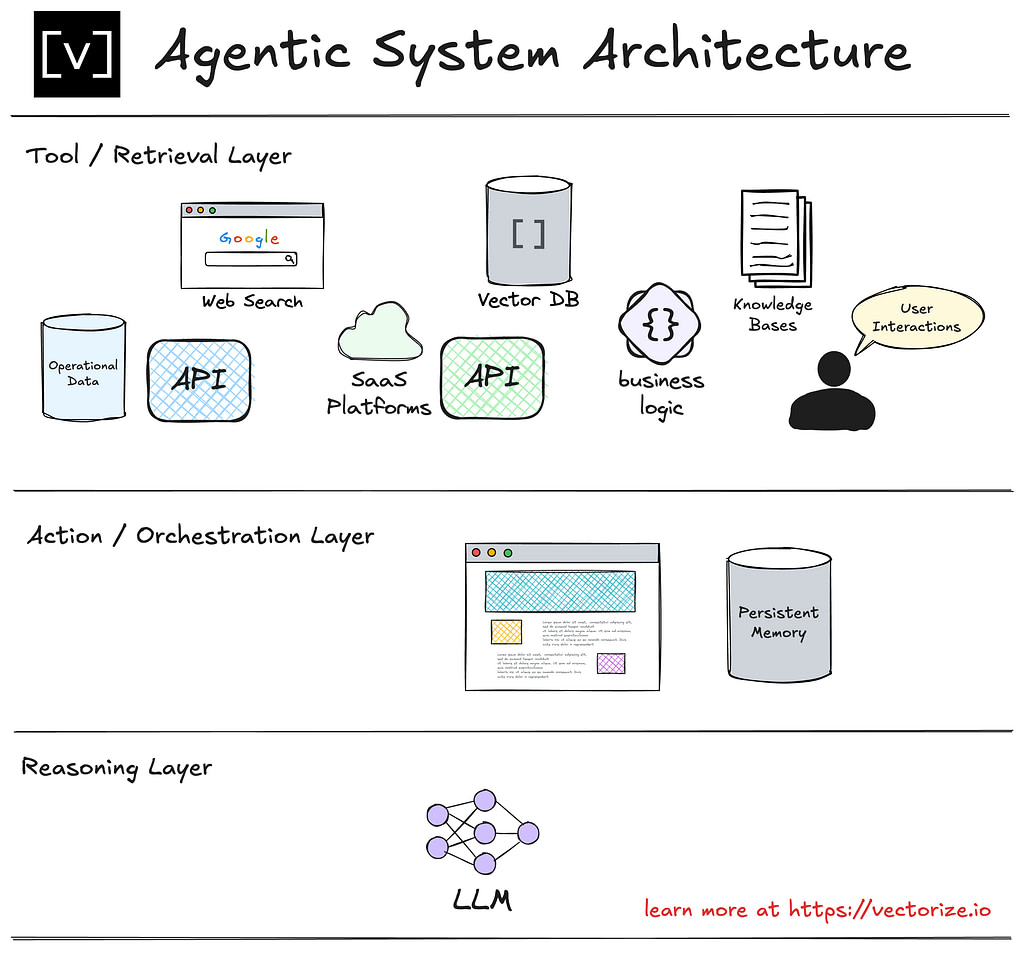
An AI agent consists of several essential components that work together to enable its functionality:
The core intelligence of the agent, responsible for understanding instructions, reasoning about problems, and generating responses. The LLM provides the cognitive capabilities that allow the agent to process information and make decisions.
Different models have different strengths and capabilities, affecting the agent's performance across various tasks.
Extensions that allow the agent to interact with external systems and perform actions. These can include:
- Web search capabilities
- Database access
- File operations
- Communication with other services
- Specialized functions for specific domains
Tools enable the agent to go beyond just generating text and actually accomplish tasks in the real world.
Systems that allow the agent to maintain information across interactions. This includes:
- Short-term memory for the current conversation
- Long-term memory for persistent information
- Retrieval systems to access relevant knowledge
Memory enables continuity and coherence in the agent's behavior over time.
The system that coordinates the agent's activities, managing the flow of information between the LLM, tools, and memory. This layer handles:
- Determining when to use which tools
- Managing the sequence of operations
- Handling errors and exceptions
- Implementing guardrails and safety measures
The guidance that shapes the agent's behavior and capabilities. Well-crafted instructions are crucial for:
- Defining the agent's purpose and scope
- Establishing behavioral guidelines
- Setting performance expectations
- Providing domain-specific knowledge
Capabilities
Modern AI agents can perform a wide range of tasks, including:
Information Retrieval
Searching for and synthesizing information from various sources to answer questions or provide insights.
Task Automation
Executing repetitive workflows and processes with minimal human intervention.
Content Creation
Generating text, code, images, and other content based on specifications.
Decision Support
Analyzing data and providing recommendations to assist human decision-making.
Conversational Interaction
Engaging in natural, context-aware dialogue to understand and fulfill user needs.
System Integration
Connecting and coordinating between different software systems and services.
Real-World Examples
AI agents are being deployed across various domains to solve real-world problems:
These agents handle customer inquiries, troubleshoot issues, and process requests. They can:
- Answer product questions
- Resolve common problems
- Process returns or exchanges
- Escalate complex issues to human agents
By handling routine inquiries, these agents free up human customer service representatives to focus on more complex or sensitive issues.
These agents help researchers gather and analyze information. They can:
- Search for relevant literature
- Summarize findings
- Extract key data points
- Generate reports
Research assistants accelerate the discovery process by automating time-consuming information gathering and processing tasks.
These agents help developers write, debug, and optimize code. They can:
- Generate code based on specifications
- Explain existing code
- Identify and fix bugs
- Suggest optimizations
- Answer programming questions
Coding assistants enhance developer productivity by automating routine coding tasks and providing just-in-time guidance.
These agents help individuals manage their daily tasks and information. They can:
- Schedule appointments
- Set reminders
- Answer questions
- Provide recommendations
- Automate routine communications
Personal assistants help users save time and stay organized by handling routine tasks and providing timely information.
Test Your Understanding
What is the primary difference between traditional software and AI agents?
Which component provides the core intelligence for an AI agent?
What enables an AI agent to interact with external systems?